
B2B Link Building Agency
B2B link building agency for companies with long sales cycles and short patience. We build editorial links and digital PR for software and B2B companies whose growth pages have to outrank better-funded competitors — relevance first and volume second, with reporting tied to organic growth on the pages that actually drive pipeline.
No public pricing. Every engagement is scoped and quoted to your site, your category, and your goals.
Verticals
SaaS, fintech, cybersecurity, HR tech, logistics, dev tools, and professional services
Network
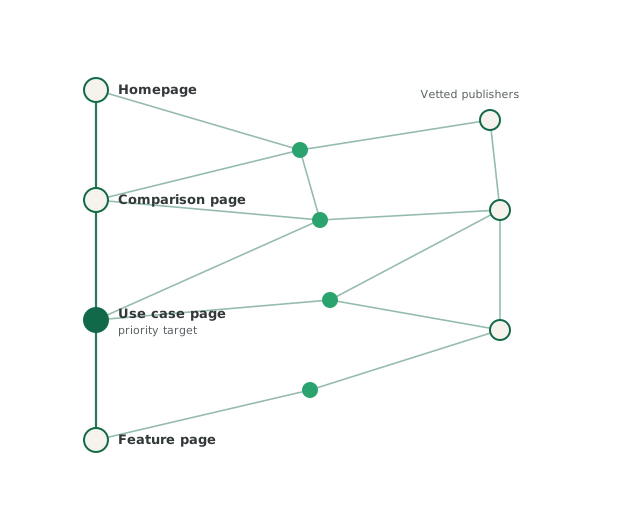
Publishers and journalists vetted for real organic traffic and topical relevance, not domain rating alone
Campaign types
Guest posts, digital PR and data studies, niche edits, resource and partner links, and audits
What a B2B Link Building Agency does
A B2B link building agency earns relevant editorial links and press coverage for B2B and SaaS companies, so their most important pages rank higher and attract qualified organic traffic. The good ones lead with topical relevance and honest reporting, not raw link volume.
B2B link building is genuinely harder than ecommerce or consumer
Nobody wakes up wanting to link to a procurement platform. The pages a B2B company most wants to rank, its product, comparison, and pricing pages, are commercial and give writers nothing to cite. Meanwhile the people who evaluate and buy the software are almost never the people who publish content and hand out links.
So the audience that links and the audience that buys barely overlap. Most agencies paper over that gap by buying links on generic marketing blogs that also cover crypto, health, and travel. Those links carry almost no topical relevance, and Google can see it. The report looks busy. The rankings do not move.
We built this B2B link building agency around the awkward parts of B2B instead of pretending they are not there. Long sales cycles make attribution messy. Most B2B products are boring to link to. Executives want links pointing at the pricing page, and that rarely works. And link building alone will not rescue a site with no real search demand behind it. We would rather say that on the first call than discover it in month six.
Six services, one job: relevant authority on the pages that matter
Each service solves a different link problem. Most engagements blend a few of them, sequenced to your stage and your category.
A campaign, in the order we run it
Outreach is the fourth step, not the first. What comes before it decides whether the links do anything.
- 01
Technical and backlink audit
We start by reading what you already have: your backlink profile, anchor text distribution, indexation, and any technical issues holding pages back. If an inherited profile has risk in it, we flag it before we add anything new.
- 02
Competitor gap and target mapping
We pull the sites linking to your search competitors but not to you, filter hard for relevance and real organic traffic, and map which of your pages can actually convert authority into rankings. That becomes the target list.
- 03
Asset and angle development
Some pages can earn links as they are. Others need something worth citing first: original data, a benchmark, a framework, or a genuinely useful guide. We build the angle before we pitch it, because outreach without a reason to link goes nowhere.
- 04
Outreach and vetted placement
We only place links on sites that pass our checks: meaningful and rising organic traffic, a healthy outbound link ratio, topical relevance to your category, clean indexation, and a traffic trend heading the right way. You approve every site before anything goes live.
- 05
Reporting tied to organic growth
We report the chain from links placed to rankings on your revenue pages to qualified organic traffic and influenced pipeline. Not average domain rating with no context. If something is not working, you hear it from us first.
The main B2B link types and when each earns its keep
No single link type carries a campaign. Mixing them is also what keeps referring domain growth and anchor text looking natural rather than bought.
| Link type | What it is | Best used for | Turnaround | Effort / risk |
|---|---|---|---|---|
| Editorial guest post | A contributed article with a contextual link on a relevant publication | Building topical relevance to chosen pages | 3 to 6 weeks | Moderate effort, low risk when sites are vetted |
| Digital PR / data study | Original research or expert commentary journalists cite on their own | Authority and mentions from sites that never accept guest posts | 6 to 12 weeks | High effort, variance in outcome, low risk |
| Niche edit | A link added inside an existing, already-indexed article | Faster placement when a relevant host page already ranks | 1 to 3 weeks | Low effort, low to moderate risk |
| Resource / partner link | A mention on a curated list, integration page, or partner directory | Bottom-of-funnel relevance and referral traffic | 2 to 8 weeks | Low effort, low risk |
B2B categories, at every stage
We work with companies where organic search drives real pipeline and the competition for it is stiff. Stage matters as much as vertical, because the right program looks different at seed than at Series C.
Verticals
- SaaS
- Fintech
- Cybersecurity
- HR tech
- Logistics and supply chain
- Professional services
- Developer tools
- Agencies and consultancies
Company stage
- Seed and pre-revenue teams testing search demand
- Series A to C companies fighting for competitive terms
- Established brands and in-house SEO teams that need outsourced link supply
The tactics we turn down, and why they fail in B2B
A lot of what gets sold as link building is cheap for a reason. Here is what we refuse, even when a client asks for it.
Private blog networks
PBNs are sites built to pass links, not to serve readers. They carry no real relevance, leave footprints, and put your domain one deindexation away from losing every link at once. The downside dwarfs the upside.
Reciprocal swaps dressed up as partnerships
You link to me, I link to you, and we both call it a partnership. Google has been explicit that reciprocal links built to manipulate rankings are a violation. In B2B the swaps are usually irrelevant anyway.
Bulk directory submissions
A handful of category-relevant directories can be worth it. A spreadsheet of 300 generic ones is a footprint that signals manipulation and moves nothing. Volume here is a liability, not a metric.
Sites that sell to every vertical
A blog running posts about SaaS, crypto, health, and travel in the same week has no topical authority in your category. The relevance signal is close to zero, so the link does close to nothing for a B2B site.
Sites with no organic traffic
If a host page never ranks and no human reads it, a link on it is decoration. High domain rating with a flat traffic line usually means a manufactured profile, not authority Google trusts.
AI-generated host blogs
Sites filled with unedited generated filler and no real author get caught in scaled-content enforcement. A link there ties your name to a site living on borrowed time.
Guaranteed ranking promises
Nobody controls Google's rankings, and publishers make their own editorial calls. We guarantee the process, the vetting, and honest reporting. Anyone guaranteeing position one is guessing or lying.
Including the uncomfortable ones. If a question you have is not here, put it in the form and we will answer it straight.
B2B link building, answered honestly
- How long before B2B link building affects rankings and pipeline?
- Links get indexed within days to a few weeks. Ranking movement on competitive B2B terms usually appears between two and four months in and compounds after that. Pipeline lags further because B2B sales cycles run for months, so influenced pipeline shows up across a full cycle rather than in a neat monthly line. Anyone promising ranking jumps in 30 days is selling you something.
- How do you attribute links to pipeline in a long sales cycle?
- We report a chain rather than a single number: relevant links placed, ranking movement on the specific revenue pages we target, qualified organic traffic to those pages, conversions, and influenced pipeline over the length of your sales cycle. We use influenced pipeline, not last-click, because a B2B buyer touches many things before booking a demo. We never invent a direct revenue figure the data cannot support.
- Can we see the sites before you place a link?
- Yes. You approve every publication before we place anything. We share the site, its organic traffic and trend, topical relevance to your category, and why it made the list. If a site fails our vetting, it never reaches you in the first place. You are never surprised by where a link landed.
- What is the minimum engagement length?
- Link building is slow by nature, so one-off placements rarely move anything. We usually work in engagements of at least three to six months so there is time for links to index, rankings to respond, and reporting to show a real trend. If your goal is a handful of links this week, we are probably not the right fit.
- Do you work with our direct competitors?
- Not in the same category and market at the same time. If we are running campaigns for you, we will not take on a company you directly compete with for the same keywords in the same region. We are happy to put reasonable exclusivity in writing so there is no ambiguity.
- How often do you report, and what is in the report?
- Monthly, with a live view you can check any time. Reports cover links placed and their relevance and quality, ranking changes on your priority pages, organic traffic and conversion trends on those pages, and influenced pipeline where your analytics support it. We deliberately avoid vanity metrics like average domain rating with no context.
- How does scoping and quoting work, and why is there no pricing on the site?
- Every quote is custom, because the right program for a seed-stage startup and a Series C brand share almost nothing. We scope based on your category competitiveness, target pages, current profile, and goals, then send a plan and a quote. Publishing a rate card would be misleading, since it would be wrong for most situations. You get a real number after a short conversation, with no obligation.
- What happens if rankings do not move in six months?
- First we diagnose why, honestly. Sometimes the issue is not links at all: weak on-page content, technical problems, keyword difficulty beyond your current authority, or a product with little real search demand. If links are the constraint, we adjust targets and tactics. If they are not, we tell you plainly rather than selling you more links into a wall. We would rather keep a client for years than bill for work that will not land.
- What tools and data do you work with?
- We use Ahrefs and Semrush for backlink and gap analysis, Google Search Console for indexation and branded search trends, and your analytics and CRM for downstream conversion and pipeline signals. We are tool-agnostic about your stack and will report into whatever you already use.
- Do you guarantee a specific number of links or rankings?
- No, and we would distrust anyone who does. Publishers make their own editorial decisions, and Google controls rankings. We guarantee the process, the vetting standard, the relevance of every placement, and honest reporting. We commit to effort and quality, not to outcomes that are not ours to promise.
Tell us what you are trying to rank, and we will scope it.
Send us your site, your target pages, and the competitors beating you. You get a scoped plan and a custom quote, not a template and a rate card.
No public pricing. Every quote is scoped to your site and goals. We reply within one business day.